More Money, More Problems?
The Sports Psychology behind student athlete mental health
While NIL money is seen by many as a positive and a way for athlete to be compensated for their name, image, and likeness being used by a university, it can cause deeper psychological issues without people realizing it.
In the journal, Name, Image, and likeness and the health of the young athlete: A call to action…, it stated, “NIL engagement may contribute to student-athlete burnout, which impacts athletic and academic performance due to the additional tasks, such as brand management, as well as the legal and contractual responsibilities they incur.”
My cousin, Jayden Jackson explained that at times when looking for an NIL deal it can feel as though the player is merely “a product of the university.”
Additionally, the stress of comparison between teammates can lead to a decline in mental health and confidence in athletes, along with the stress of trying to negotiate a contract.
In a team setting, everyone wants to know what’s going on. With NIL deals and especially smaller local ones, competitiveness and jealously can spread throughout a team. In this scenario let’s say you say your teammate get an NIL deal before, and one that you were specifically gunning for. As an athlete you may feel like maybe it should’ve been you or that you should’ve tried harder to promote yourself. This can lead to a lowered self-esteem or Dr. Hannah Levy, sports psychologist at NAU said it can lead to the feeling that there’s not enough being done to support yourself thus feeling like everything the athlete worked for could be at stake.
In an interview with NAU women’s basketball player Audrey Taylor, she explained that once NIL came to NAU in 2021, comparison between athletes was a difficulty she faced.
“I think NIL is like, kind of hard to navigate just with, like, jealousy and like, seeing other people be so successful. Whether it's like, within your same school or at other schools, it's harder to compare with, like, bigger schools, because if you're at the Power five level, your athletic department is going to be more focused on NIL deals,” said Taylor.
While NIL is a positive aspect for athletes it creates additional stressors that affect their mental health and academic performance.
Athletes are having to maintain at least 20-hour activity weeks towards their sport, many going over the 20-hour minimum to enhance their performance. This comes from watching film, practicing, game time, weights, etc.
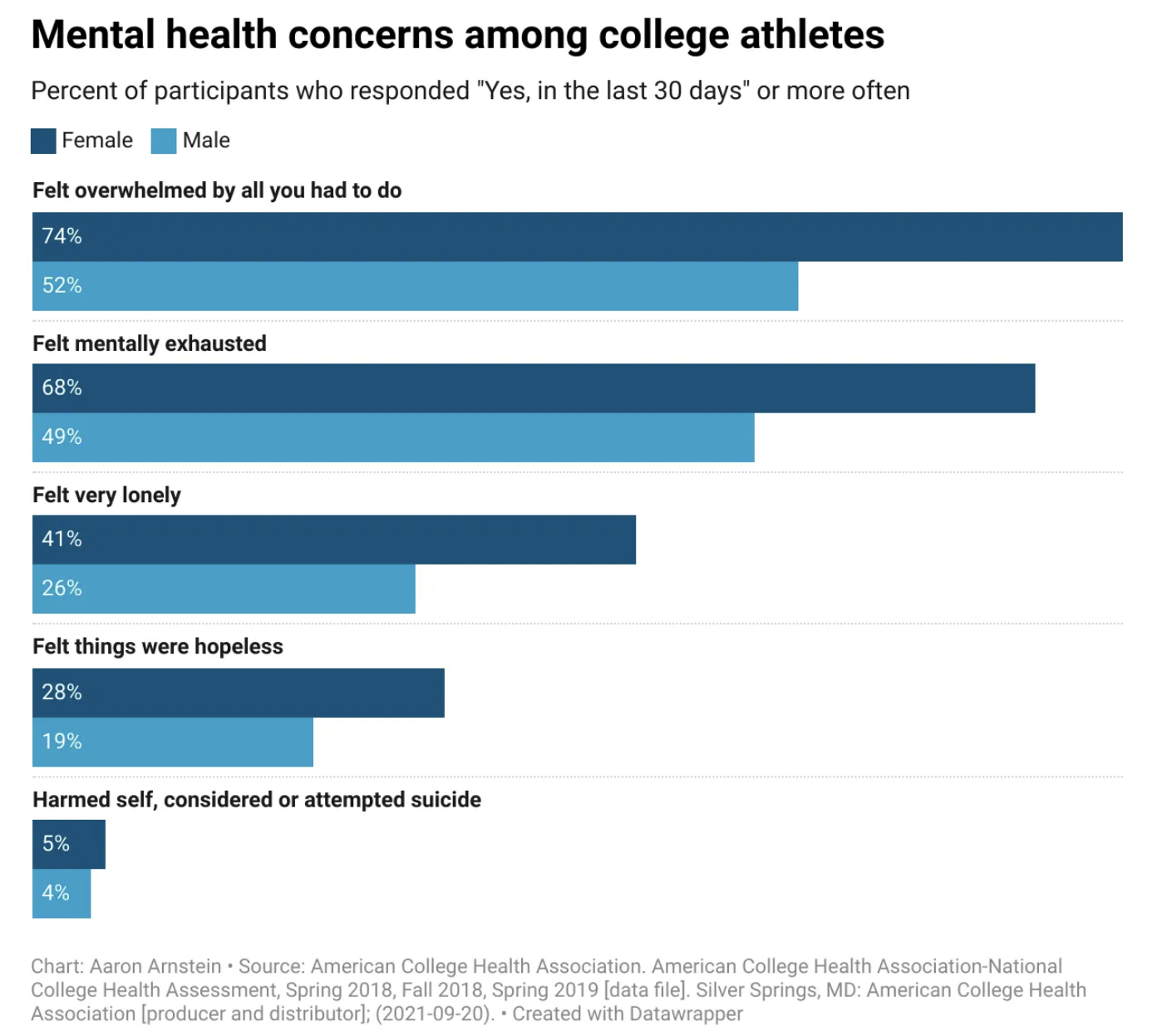
Figure 1: Graph of Mental Health Concerns Among Athletes separated by male and female. Courtesy of Kyle Harbison.
Student-athletes are at risk for depression due to the deep-rooted identification within the sport. Many athletes grow up playing sports and from then on feel as if the sport is a part of their identity and it makes up who they are.
From personal experience, I grew up playing sport and suffered an ankle injury at the beginning of my junior year in high school. This injury prohibited me from playing soccer, a sport I grew up loving more than anything.
After missing my junior year season, I didn’t really know what to do. I was really upset that I basically had to quit soccer and not on my own terms. I understand where athletes can feel as though the desires to play pro one day can just vanish.
Many athletes who get injured from a sport tend to face severe identity crisis and don’t often come back to the sport post injury/rehabilitation.
With the additional pressure of NIL that athletes face, it can be difficult to main a business perspective while also trying to enjoy the college years of that sport, what may be the last before going pro.
These stressors can lead to a performance decrease in some athletes.
Walk-ons is a term for athletes without a given scholarship prior to coming to the university. These athletes account for 46% of the NCAA college football players as a whole. (Madden & O’Hallarn, 2024).
Student athletes are having many busy schedules on top of feeling like they have to support themselves in order to be able to remain enrolled at a school, especially those not on scholarship.
Student-athlete mental health should be promoted further at more universities with stronger programs and a bigger emphasis to seek help if needed. According to the National Athletic Trainers’ Association (NATA), support and encouragement are the biggest factors in pushing a student-athlete to reach out in times of need.
REFERENCES:
Audrey Taylor
Dr. Hannah Levy
Hannah.Levy@nau.edu
Jayden Jackson
Jayden.9.dj@gmail.com
29, S. (2023, September 29). Nil, Transfer Portal and Mental Health. NATA. https://www.nata.org/nata-now/articles/nil-transfer-portal-and-mental-health
Hollabaugh, W. L., Jeckell, A. S., & Diamond, A. B. (2024). Name, image, and likeness and the health of the young athlete: A call to action for sports medicine providers and the athletic healthcare network. Sports Health, 16(2), 209-212. https://doi.org/10.1177/19417381231212645
Home runs touchdowns and depression | by Kyle Harbison | medium. Medium . (2023, December 13). https://medium.com/@kjharbison1/mental-health-in-college-athletes-b1b802278ae1
Madden, E., & O’Hallarn, B. (2024). “The Game Was Ruined For Me There:” Examining the Mental Health Byproducts of the Transfer Portal and NIL on Student-Athletes. Journal of Athlete Development & Experience (JADE), 6(2), 64–77. https://doi-org.libproxy.nau.edu/10.25035/jade.06.02.01
NCAA.org. (2022, May 26). Mental health issues remain on minds of student-athletes. https://www.ncaa.org/news/2022/5/24/media-center-mental-health-issues-remain-on-minds-of-student-athletes.aspx